
Understanding Safe Working Load (SWL) Signs for Pallet Racking
There has been a noticeable increase in interest around Safe Working Load (SWL) signage in recent months. This is being driven by rack audits, ISO9001 audits, WorkSafe site visits, and internal compliance reviews.
Across the industry, many businesses fall into one of the following situations:
No load signs installed
Load signs on some racking but not all
Load signs that no longer match the current configuration
Load signs that are unclear or difficult to interpret
As a result, two questions come up frequently:
“Do I need load signs?” and “How do I interpret them—what’s the maximum load?”
Below is a clear explanation to address both.
1. Do I need load signs?
The widely recognised standard governing pallet racking design, installation, and ongoing use is AS4084-2023. This standard is referenced by all credible auditors and compliance assessors.
AS4084-2023 clearly states that Safe Working Load signs shall be installed, and must display:
Permissible unit loads for pallets, beam levels, and bays
Maximum height from the base plate to the first beam level
Maximum beam pitch between subsequent beam levels
Operational safety guidelines
Manufacturer and installer details
Installation date
Tolerance grade (1–3: Forklifts, guided forklifts, automated equipment)
Structural designer’s details
If you want to comply with AS4084-2023, the answer is yes—you do need Safe Working Load signs.
2. How do I interpret my load signs? What’s the maximum load?
AS4084-2023 provides the below standardised SWL sign layout which is adopted by most reputable racking suppliers. However, this format is often misunderstood.
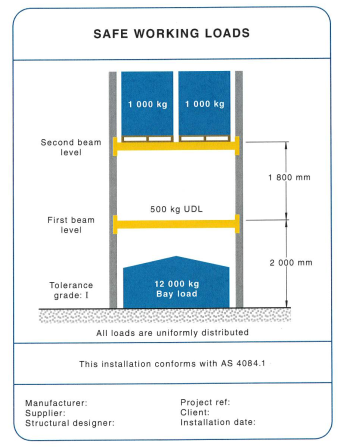
At first glance, the example image on the sign only shows two storage levels with specific load capacities— 2 × 1000 kg pallets on the second level and 1 × 500 kg UDL on the first level—and a total bay load of 12,000 kg.
This raises the following commonly asked questions:
“What about the beam levels above the second level?”
“Why is the first beam level different”
“Why doesn’t the bay load equal the total of the pallet loads shown?”
It’s important to note that this diagram is not a representation of your actual installation. It is a generic illustration used purely as a schematic to display the required load information.
• The top beam level shown in the diagram indicates the maximum load capacity for every pallet beam level in your system—not just the level pictured.
• The first beam level typically represents any hand-stacked shelving and shows the maximum uniformly distributed load (UDL) for that shelf. If your system has no shelf levels, this field is usually left blank.
However, this template can still be unclear when racking systems have many varying beam heights, beam counts, or mixed shelving types. In these situations, Dexion Supply Centre Auckland can provide a customised load sign that clearly presents all information, reflecting your system and the AS 4084:2023 requirements.
So what is the maximum load capacity of your racking?
The maximum capacity of a pallet racking system is determined by how all engineered elements interact and is assessed through detailed engineering analysis.
Key factors include:
Material grade and component construction
Frame bracing and design
Beam-to-frame connector strength
Floor fixings
Floor slab capacity
Site-specific seismic requirements
Your SWL sign specifies the maximum load permitted on each individual storage level. However, the maximum bay load is not always the simple sum of these levels. Additional engineering constraints may limit the total allowable load on the structure. It is essential to pay close attention to the maximum bay load shown on the sign—exceeding this limit can compromise the safety and integrity of the racking system.
A final important point
AS4084-2023 requires that SWL signage must always reflect the current racking configuration. Any modification—adding or removing beam levels, changing storage methods, replacing components or mixing different manufacturers —may alter the system’s original design capacity.
Updated signage must be produced by a competent person following reassessment.
Without accurate, current signage, you may unknowingly overload your racking and create a risk to staff and equipment
If you have any doubts about the compliance, load sign accuracy, or safety of your racking system, you are welcome to contact Dexion Supply Centre Auckland for a formal assessment or simply a friendly conversation. We’re here to help.