
A pallet is needed for dispatch. The warehouse system identifies the stock, an instruction is issued, and automated equipment begins moving it towards the collection point.
It sounds straightforward, but several different systems need to work together to make that movement happen.
The warehouse software must identify the correct pallet and its location. The equipment needs to know where to travel, how to access the load and where to deliver it. Meanwhile, the racking must accommodate those movements safely and accurately.
This coordination is what makes an Automated Storage and Retrieval System (ASRS) work.
Let's follow a typical pallet retrieval to understand how the different elements come together.
1. It Starts With an Inventory Instruction
Before any equipment moves, the system needs to know which pallet is required and where it is stored.
In an integrated warehouse, this information is generally managed through a Warehouse Management System (WMS), which maintains inventory records and coordinates warehouse activities.
When an order requires a particular pallet, the WMS identifies the relevant stock and its recorded storage location. Depending on how the warehouse operates, it may also apply stock rotation rules, such as First In, First Out (FIFO), or prioritise particular orders.
The resulting retrieval request is communicated to the automation system.
At this stage, the task exists as information. Nothing has physically moved yet.
2. The Software Translates the Request Into a Movement
Knowing where a pallet is stored is one thing. Getting the equipment to retrieve it is another.
This is where the automation control system comes in.
Depending on the installation, a Warehouse Control System (WCS) or other control software receives the request and coordinates the equipment needed to complete it.
For example, the system may need to determine:
Which shuttle or storage and retrieval machine should carry out the task.
What route the equipment needs to follow.
Whether the destination and transfer points are available.
How the movement fits alongside other tasks already underway.
The equipment's own control systems then execute the necessary movements, using sensors and other feedback to monitor their progress.
The exact software arrangement varies between installations. Some systems separate warehouse management, equipment coordination and machine-level control, while others combine several functions within an integrated platform.
The important point is that a warehouse-level instruction must be translated into a sequence of physical actions.
3. The Racking Provides the Operating Environment
Once the movement has been planned, the equipment must operate within the storage structure.
In an automated warehouse, racking does more than support stored goods. Its dimensions, configuration and structural design directly influence how the handling equipment can move.
Depending on the ASRS technology, cranes may travel along designated aisles, while automated shuttles move through storage channels or across interconnected routes.
The structure must accommodate the equipment's operating clearances, movement paths and the loads imposed during storage and retrieval.
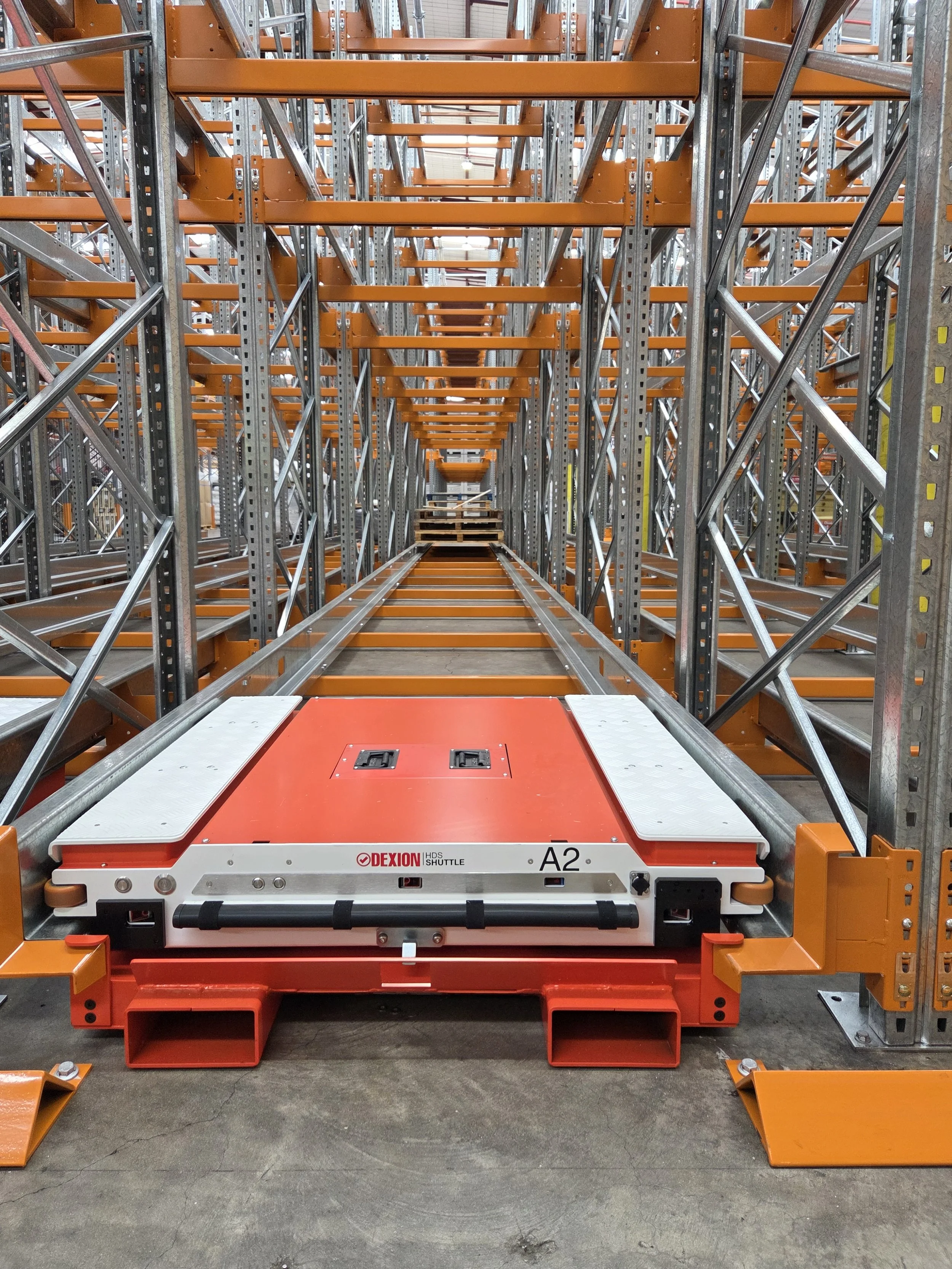
This relationship between the structure and the equipment can also be seen in semi-automated systems such as Dexion's HDS Shuttle.
The HDS uses a battery-powered shuttle travelling on support rails within deep storage lanes. Although its movements are initiated by an operator using an RF remote, the racking and equipment still need to work together precisely.
Fully automated systems take this relationship further by coordinating movement across a larger storage network.
For this reason, automated storage design requires the racking and handling equipment to be considered as parts of the same system, rather than separate installations.
4. The Equipment Retrieves the Pallet
With the task assigned and an appropriate route established, the handling equipment performs the retrieval.
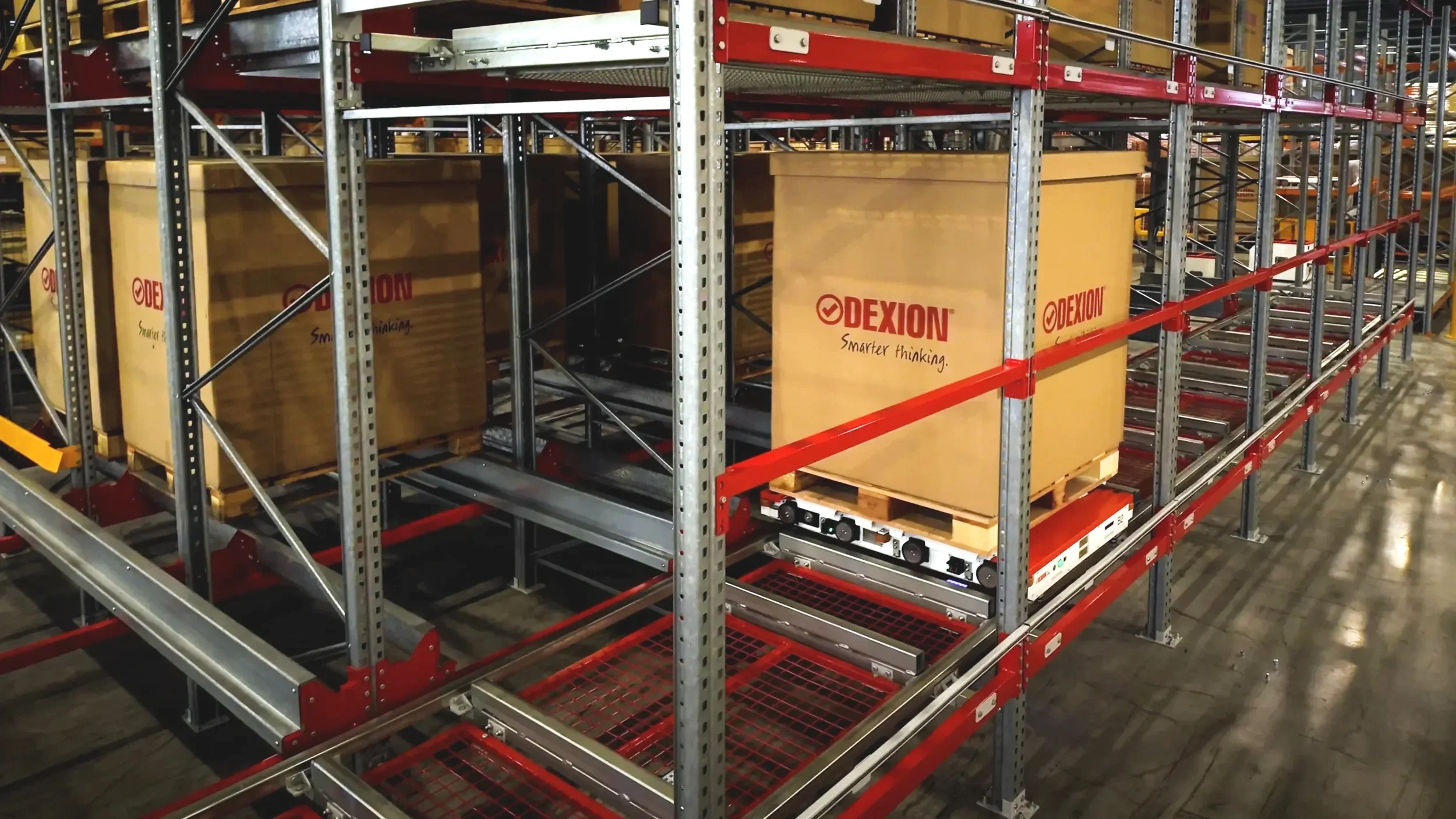
In a crane-based ASRS, a storage and retrieval machine travels to the specified location and uses its load-handling mechanism to collect the pallet.
In a shuttle-based ASRS, automated vehicles transport pallets through the storage structure, sometimes working alongside lifts or other transfer equipment.
Dexion's Multi-Directional Shuttle (MDS) ASRS provides an example of this approach.
Unlike the RF-controlled HDS Shuttle, the MDS ASRS uses autonomous multi-directional shuttles, integrated controls and software to coordinate pallet movements through a high-density storage system.
Dexion describes the system as incorporating intelligent routing and traffic coordination, allowing multiple shuttles to operate within the same storage environment.
The physical equipment performs the movement, while the control system manages how that movement fits into the wider operation.
5. The Movement Must Be Confirmed
Retrieving the pallet is only part of the process.
The control system also needs to establish whether the task was completed successfully.
Sensors and equipment feedback help confirm that the movement has occurred and that the pallet has reached the expected position.
The automation system can then communicate the appropriate completion status back to the warehouse software.
Depending on the integration, this may trigger an inventory location update, confirm the completion of a warehouse task or initiate the next stage of an order.
This exchange of information is essential because the digital inventory record must remain consistent with the physical movement of goods.
Without reliable confirmation, a system could lose track of where stock is located or whether a requested movement has been completed.
6. The Pallet Moves to the Next Operation
Once retrieved, the pallet may need to move through additional equipment before reaching its final destination.
Depending on the warehouse layout, this could involve a conveyor, transfer station or designated collection point.
From there, the pallet might enter a picking process, move into a staging area or become available for dispatch.
These connections are important because the performance of an automated storage system depends on more than the speed of the equipment inside the racking.
If retrieved pallets cannot move efficiently into the next stage of the operation, congestion can develop at the transfer points.
The storage system therefore needs to be designed around the wider warehouse workflow.
What Happens When Something Doesn't Go to Plan?
Automation also needs a way to respond when a movement cannot be completed as expected.
A pallet might fail a dimensional check, a transfer position could be occupied, or a machine may report a fault.
Depending on the system's capabilities, the control software may pause the movement, allocate an alternative task, report an exception or request operator intervention.
These scenarios need to be considered during system design.
Reliable automation depends on accurate communication, appropriate safety controls and clear procedures for recovering from interruptions.
An automated warehouse still requires people to monitor performance, manage exceptions and maintain the equipment.
Why the Complete System Matters
Looking at the retrieval process reveals how closely the different elements are connected.
The warehouse software knows what needs to move. The control system coordinates how the task will be completed. The equipment carries out the physical movement, and the racking provides the engineered environment in which it operates.
Every stage depends on information or physical conditions established by another part of the system.
This is why the early planning of an ASRS installation should extend beyond selecting equipment and calculating storage capacity.
The design also needs to establish how inventory information will be exchanged, how equipment movements will be coordinated, how transfers will be managed and what happens when an operation cannot proceed as expected.
Thinking Beyond the Equipment
Warehouse automation can take many forms, from operator-controlled pallet shuttles to fully integrated automated storage and retrieval systems.
The level of automation may differ, but the underlying principle remains the same: the storage structure, handling equipment and operating processes need to work together.
Understanding these relationships helps warehouse operators assess not only what automated equipment can do, but also what is required to make it work within their existing operation.
At Dexion Auckland, we work with businesses to understand their storage requirements and explore practical solutions for their warehouse environment.
Planning changes to your warehouse storage or considering automation? Talk to our team about your current layout and operational requirements as a starting point for assessing the available options.